An examination of equipment finance activity, borrowing trends, and the factors influencing equipment purchases across U.S. businesses.
Equipment financing is having a strong year. Whether that strength is being felt equally across the businesses purchasing equipment is another question.
Through August 2026, new business volume among companies reporting to the Equipment Leasing & Finance Association (ELFA) was up 17.3% compared with the same period in 2025. On a seasonally adjusted basis, July set an all-time monthly record at $14.3 billion, while August followed at $11.8 billion, the second-highest month recorded by ELFA’s CapEx Finance Index.
Those are impressive numbers for an industry navigating inflation, borrowing costs, and economic uncertainty. But there is more to the story than record financing volume.
The Federal Reserve Banks’ 2026 Report on Employer Firms found that 42% of small employer firms that applied for financing in the 2025 Small Business Credit Survey received the full amount they requested. These findings describe financing experiences reported in 2025, not financing access during 2026, and cover business financing broadly rather than equipment loans and leases specifically. They provide context for a useful question: As equipment finance volume grows, how much of that growth is translating into better access to capital for individual businesses?
Equipment Financing Is Growing, but Not All Demand Is the Same
The first eight months of 2026 have been particularly strong for equipment finance companies.
According to ELFA’s CapEx Finance Index, August’s $11.8 billion in seasonally adjusted new business volume was below July’s record but remained substantially above the corresponding month in 2025.
July’s record was driven in part by AI-related capital investment. That matters when interpreting the broader market. Large technology infrastructure investments can lift national financing totals without necessarily reflecting the experience of a contractor buying machinery, a restaurant replacing kitchen equipment, or a manufacturer expanding a production line.
The strength was not limited to large transactions. ELFA also reported that small-ticket financing activity was up 25.9% through August compared with the same period in 2025. That points to growth beyond large deals, although transaction size alone does not establish how evenly gains were distributed across industries or business sizes.
Equipment financing covers a wide range of industries, each with different purchasing cycles and financial pressures. The national numbers are encouraging. Understanding where that growth is coming from matters just as much as the total.
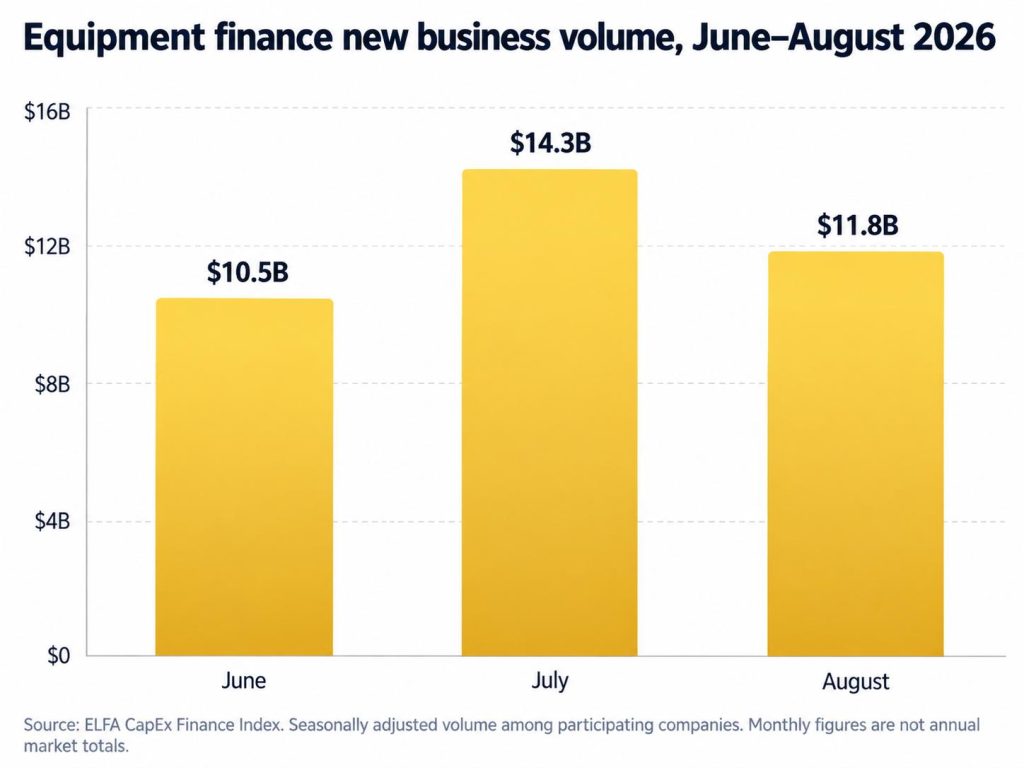
Chart figures are as reported in ELFA’s respective June, July, and August 2026 releases. ELFA updates seasonal adjustments monthly, so historical figures may be revised.
Why Businesses Continue to Rely on Equipment Financing
Equipment financing is not simply an alternative for companies that cannot afford to pay cash. For many businesses, it is part of managing capital expenditures and preserving flexibility.
The Equipment Leasing & Finance Foundation’s 2024 Horizon Report estimated that the U.S. equipment finance industry reached $1.34 trillion in 2023. Its survey found that 82% of respondents who acquired equipment or software in 2023 used at least one form of financing for those purchases.
Consider a contractor purchasing machinery for a larger project. Even if the company has enough cash to buy the equipment outright, making that purchase could limit the funds available for payroll, materials, and day-to-day operations. A manufacturer replacing an aging production machine faces similar trade-offs.
Equipment financing gives eligible businesses a way to evaluate the cost of equipment alongside their other financial commitments instead of treating every purchase as a single upfront expense.
That does not mean financing is always the better choice. Borrowing costs, repayment terms, equipment lifespan, and the company’s financial position all influence the decision. But it helps explain why financing remains so widely used, even when the economy is uncertain.
Strong Financing Volume Does Not Mean Easier Access to Capital
ELFA’s August 2026 CapEx Finance Index reported an average credit approval rate of 75.4%, down 2.0 percentage points from July. Strong financing volume can coexist with a decline in approval rates among participating finance companies.
A separate Federal Reserve survey provides broader context on small-business financing experiences.
In its 2026 Report on Employer Firms, based on the 2025 Small Business Credit Survey, the Federal Reserve Banks found that 60% of surveyed small employer firms had applied for financing during the 12 months leading up to the survey. The survey was conducted from September through November 2025 and covered firms with 1–499 employees.
Among those that applied:
- 42% received the full amount requested.
- 36% received some or most of the amount requested.
- 22% received no financing.
These are broader small-business financing figures, not equipment financing approval rates. The Federal Reserve’s full-funding measure and ELFA’s approval rate describe different populations, periods, and outcomes and should not be compared directly. Still, they illustrate a challenge relevant to any company considering a major purchase: needing equipment and qualifying for financing are two different things.
Credit history, current obligations, cash flow, time in business, and the equipment itself can influence a lender’s evaluation. For vendors, this is one reason to bring financing into the conversation before the customer reaches the final stages of a purchase.
Discussing payment options earlier does not guarantee approval. It can, however, give buyers more time to understand the process, assemble documentation, and evaluate what fits their budget.
The Cost of Financing Remains Part of the Purchasing Decision
Access to financing is only one part of the equation. The actual cost of borrowing matters just as much.
In the Federal Reserve Banks’ 2025 survey, published in the 2026 employer-firm report, 60% of respondents who borrowed from online lenders reported higher-than-expected borrowing costs. Although that finding is not specific to equipment financing, it highlights the importance of understanding financing terms before committing.
For an equipment purchase, monthly payments are often the first numbers a buyer wants to see. But a payment estimate does not tell the entire story.
Businesses should also consider:
- The total amount payable over the financing term
- The length and structure of the repayment schedule
- Any upfront costs and applicable fees
- Whether a down payment is required
- Any end-of-term obligations or early repayment restrictions
A lower monthly payment may be easier to accommodate in the short term, while a longer repayment period can increase the total cost of financing. The right balance depends on the business and the equipment being purchased.
Businesses exploring a purchase can use Centra Funding’s equipment financing calculator to estimate potential monthly payments before applying.
Equipment Vendors Have a Role in the Financing Conversation
Equipment vendors have traditionally focused on helping customers select the right equipment, understand its capabilities, and make the purchase. Financing adds another consideration to that process.
The Equipment Leasing & Finance Foundation’s 2024 Horizon Report estimated that manufacturers and vendors accounted for approximately 17% of equipment financing volume in 2023. That is a meaningful share of the market.
A buyer comparing equipment may be considering not just which machine will get the job done, but whether the purchase fits within the company’s operating budget.
Vendors do not have to become lenders to make the financing process easier to navigate. Providing a way to explore estimated payments, sharing information about financing options, and offering a straightforward application path can help customers make more informed decisions.
Centra Funding works with equipment sellers through its vendor financing programs, helping qualified buyers explore financing options as part of the equipment purchasing process.
Financing cannot make every purchase affordable or guarantee an approval. But giving buyers clearer information earlier can reduce uncertainty during the sales process.
Speed Matters, but So Does the Credit Decision
When a business needs equipment to fulfill a contract, increase production, or replace a machine that has failed, financing delays can have real consequences.
A contractor may be waiting for machinery to start a project. A manufacturer may be losing production time while an older system remains out of service. In these circumstances, timing matters.
But a quick decision and a sound decision are not always the same thing.
Lenders still need to evaluate repayment capacity, the financing request, and the equipment involved. Some applications are straightforward; others need additional documents or closer review.
The opportunity is to remove avoidable delays without compromising underwriting. That may involve identifying missing information sooner, improving communication with applicants and vendors, and making the process easier to follow.
Faster processing can improve the experience for borrowers. Careful credit decisions support the long-term health of financing programs. Equipment finance providers need both.
What Will Matter Most in Equipment Financing in 2027?
If the current trend continues, the equipment finance industry could enter 2027 following a particularly strong year. Record volume, however, will not tell the whole story.
Much will depend on whether investment remains strong across industries beyond technology infrastructure, how borrowing costs develop, and whether smaller businesses can obtain the capital they need.
The financing experience itself will also matter. Will businesses have better access to payment information before making purchases? Will more vendors offer financing options early in the sales process? Can lenders improve processing times without taking on unnecessary risk?
Equipment finance activity has demonstrated substantial strength in 2026. The more important question for the year ahead is how effectively that activity supports the businesses making everyday equipment investments.
Research Sources and Methodology
This report was prepared by Centra Funding using publicly available industry and business-financing research. It is an analysis of third-party sources and does not represent a proprietary index, survey, or analysis of Centra Funding customer transactions.
- Equipment Leasing & Finance Association (ELFA):
August 2026 CapEx Finance Index
and
July 2026 CapEx Finance Index.
The chart also uses the
June 2026 release.
ELFA data covers participating member companies, not the entire U.S. equipment finance market. Monthly volume figures are seasonally adjusted and subject to revision. - Equipment Leasing & Finance Foundation:
2024 Horizon Report.
Survey and market estimates cited here relate to equipment and software financing in 2023. The 82% figure concerns surveyed purchasers, while the $1.34 trillion figure is an estimated market total. - Federal Reserve Banks:
2026 Report on Employer Firms,
based on the 2025 Small Business Credit Survey.
These findings relate to broader business financing, not equipment-specific approval rates or 2026 borrowing outcomes. The survey collected 6,525 responses from a nationwide convenience sample of small employer firms with 1–499 employees; it was not a random sample.
Explore Equipment Financing With Centra Funding
Centra Funding provides business equipment financing solutions for qualified companies nationwide and works with equipment vendors to help customers explore financing options.
Whether you are replacing older equipment, investing in new machinery, or expanding operations, you can review potential payments with our financing calculator and learn more about available options.
Ready to explore equipment financing?